
Why Your Students Aren't Coming Back Next Term
Student dropout at tuition centers is rarely about dissatisfaction - it's about silence, gaps, and missed moments. Here's what's actually happening and how to retain families through to the next term.
 Corinna Hu· Content Strategist at Integratr.ai·June 2, 2026·8 min read
Why Your Students Aren't Coming Back Next Term
Walk into most tuition centers across APAC and ask the operator what their re-enrollment rate was last term. If they don't have an answer ready, that's your first signal.
Most operators who lose students don't lose them because parents are unhappy. They lose them because parents forgot why they enrolled in the first place - and by the time the next term comes around, it was easier to not re-enroll than to decide to continue.
The gap between enrollment and re-enrollment is almost always a communication gap. Here's how to retain families through to the next term.
1. Watch for the Warning Signs Before Parents Tell You They're Leaving
The student who misses two consecutive sessions without notice. The parent who hasn't opened a message in six weeks. The family with an outstanding balance who's gone quiet. These are the signals - and they're usually visible weeks before a parent calls to withdraw.
If you're tracking attendance manually, absence patterns don't surface until you've manually reviewed the register. If you're using a system that flags students trending below 75% attendance in a month, you catch it in days.
The principle is simple: reach out before the parent has already made their decision. Once they've decided to leave, the conversation is about goodbye - not retention.
2. Send a Mid-Term Check-In, Not Just an End-of-Term Report
A parent who hears from you at week 6 of a 12-week term has a completely different relationship with your center than a parent who only hears from you at week 12. That mid-term message - specific to their child, not a generic blast - keeps your center in their mind during the decision window.
The check-in doesn't need to be elaborate. One message per family that mentions something real: the topic the class finished last week, a small win the student had, their attendance trend. Five minutes per student if you have templates ready.
Parents who feel connected don't want to leave. Mid-term contact is the highest-leverage retention move most operators aren't doing consistently.
3. Open Re-Enrollment Earlier Than You Think Is Necessary
Most centers send re-enrollment forms in the last two weeks of term. By that point, parents have already been thinking about next term for weeks - quietly, without you in the conversation.
Open the re-enrollment window at the start of the final month of term. Give parents a reason to decide early: priority scheduling for next term, a guaranteed spot in the class they want, first access to the new timetable. Parents who commit early are yours for the next term. Parents who go into the last two weeks undecided often make no decision at all.
4. Send Progress Reports That Show Actual Progress
Parents pay for results. If you can't show them, they're paying for a hope and a prayer.
A progress report that shows where a student started, what they worked on, and what they can now do differently is the evidence of value. A report that's just a grade sheet doesn't create the same feeling of progress.
The structure that works: where the student started → what the tutor worked on → what the student can now do that they couldn't before. "Can now solve quadratic equations independently" is worth more than "improved in maths."
This approach takes more effort to produce. It's also significantly more effective at keeping families enrolled through the next term.
5. Know About Absences the Same Day They Happen
If you're finding out about absences at month-end billing, you're already too late. The gap has become a habit by then, and the conversation with the parent is harder.
Set up a system that alerts you when a student misses a session without notice. 24 hours after the session is the right window - early enough to call while it's still on the parent's mind, late enough to have confirmed the absence rather than chasing a late arrival.
Calling on day one of an absence is a completely different conversation than calling on day 14. Day one feels like care. Day 14 feels like an accusation.
6. Treat the First 30 Days Like They're the Entire Relationship
The first month of a student's enrollment is when dropout risk is highest. Parents are still deciding whether your center is the right fit. Students are still adjusting. This is when you set the tone - or lose the family before term two.
A simple first-30-days structure: a welcome message within 48 hours of enrollment, a progress check-in at the end of week two, and a summary at the end of week four. That's three touches in 30 days. By the time the second term starts, the family feels known rather than anonymous.
Operators who skip this step end up with families who feel like they enrolled in something generic. That's not a technical problem - it's an attention problem.
7. Set Up a WhatsApp Business Account for Your Center
If parents are messaging your personal number for everything - fee reminders, schedule changes, progress questions - your personal WhatsApp becomes the center's helpdesk. Every message from every parent gets mixed in with your personal chats.
A WhatsApp Business account costs nothing to set up. It gives your center a separate, professional presence. Messages go to the center, not to you. Notifications don't get buried. It's not a management system, but it's a start toward professional parent communication.
Don't use your personal number for center business. Draw that line early.
8. Track Which Families Have Gone Quiet
Some families drift toward leaving more than others. The signals are usually there if you know where to look: a family that hasn't opened a message in six weeks, a student's attendance that's dropped 30% this month, a parent who confirmed re-enrollment and then went silent.
If you're tracking engagement - message opens, attendance trends, payment status - these families surface automatically. Flag them for outreach before term-end. A personal check-in with a disengaged family often takes five minutes and can mean the difference between re-enrollment and an empty seat in September.
The families who go quiet are usually the ones who would have stayed if someone had just reached out.
9. Give Something Before You Ask for Anything
When re-enrollment season comes, the instinct is to send the re-enrollment form. But parents who only hear from you when you want something feel transactional.
Send something of value first: early access to next term's schedule, a set of revision tips for the subject, a summary of what the class covered this term. Then - after they've received something - make the re-enrollment offer.
The order matters. Parents who feel they've received value are more likely to commit without needing a discount as incentive. The families who respond to discount offers alone are the ones who will leave when the next discount appears somewhere else.
10. Make Re-Enrollment the Easiest Thing to Do
If re-enrollment requires a parent to find a form, fill it out, figure out payment, and remember to do all of this before a deadline, some of them won't. It's not that they don't want to re-enroll - it's that the process takes more effort than they have free attention for.
Send a direct re-enrollment link via WhatsApp. Pre-fill what you can. Offer one-click confirmation. Make payment straightforward - PayNow, bank transfer, whatever reduces friction. Every step that requires effort from the parent is a step that loses conversions.
Frictionless re-enrollment is a retention strategy. Most operators overlook it because they're focused on the big-picture stuff and miss the process details that actually determine whether a family stays or goes.
Frequently Asked Questions
What is a good student retention rate for tuition centers? Above 80% is solid. Above 90% is strong. If you're losing more than 20% of families between terms, look at your communication patterns - not your teaching quality. The problem is almost always in the gap between enrollment and re-enrollment.
How do I track student dropout at my tuition center? Count enrollment at the start of each term and re-enrollment at the start of the next. Retention rate = (students who re-enrolled / students enrolled last term) × 100. Track this every term and you'll see your trend clearly.
What's the most effective retention strategy? Mid-term check-ins. Regular, specific parent communication at the midpoint of term is the highest-leverage move most operators aren't doing consistently. It costs almost nothing in time or money.
How can I reduce dropout without discounting fees? Focus on communication quality. Parents who feel known and informed rarely leave for a cheaper center. Parents who feel neglected leave even when your fees are competitive. The discount arms race is a race to the bottom - focus on the relationship instead.
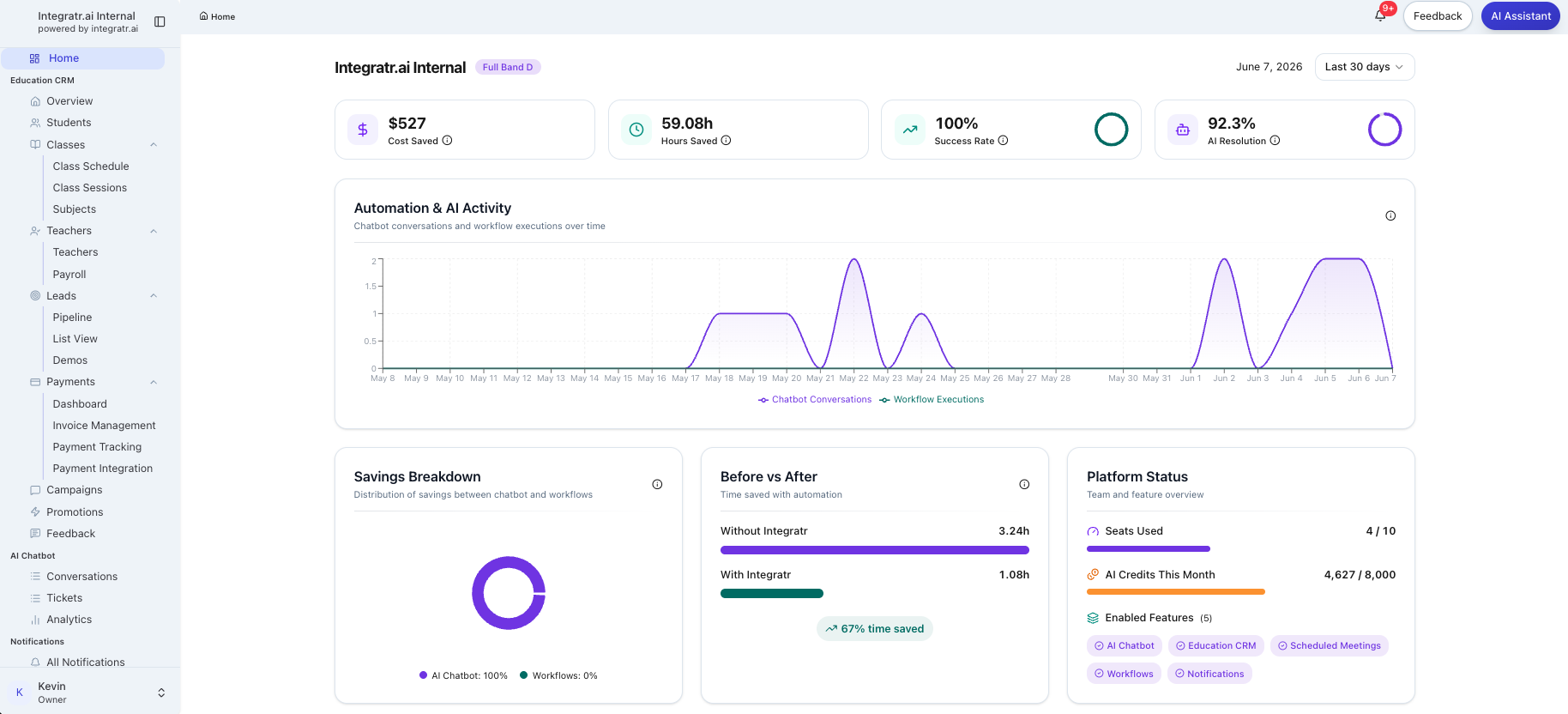
Integratr.ai's Workflow Automation handles parent retention - automated mid-term check-ins, at-risk family alerts, re-enrollment campaigns, and progress report templates for tuition centers in Singapore and Malaysia.
Book a free demo at integratr.ai or learn more about our Education solution.
Want to see how automation can work for your business?